


Roza Georgiyevna Shanina
Roza Georgiyevna Shanina (Роза Егоровна Шанина).
 She was a Red Army
sniper during World War II, credited with fifty-four confirmed hits.
Praised for her shooting accuracy,
She was a Red Army
sniper during World War II, credited with fifty-four confirmed hits.
Praised for her shooting accuracy,
Shanina was capable of precisely hitting moving enemy personnel.
Shanina volunteered for the military after the death of her brother in 1941 and chose to be a marksman on the front line. Praised for her shooting accuracy, Shanina was capable of precisely hitting enemy personnel and making doublets (two target hits by two rounds fired in quick succession).
In 1944, a Canadian newspaper described Shanina as "the unseen terror of East Prussia".
She became the first Soviet female sniper to be awarded the Order of Glory and was the first servicewoman of the 3rd Belorussian Front to receive it. Shanina was killed in action during the East Prussian Offensive while shielding the severely wounded commander of an artillery unit. Shanina's bravery received praise already during her lifetime, but conflicted with the Soviet policy of sparing snipers from heavy battles. Her combat diary was first published in 1965.


Death

In the face of the East Prussian Offensive, the Germans tried to
strengthen the localities they controlled against great odds. In a diary
entry dated 16 January 1945, Shanina wrote that despite her wish to be
in a safer place, some unknown force was drawing her to the front line.
In the same entry she wrote that she had no fear and that she had even agreed to go "to a melee combat." The next day, Shanina wrote in a letter that she might be on the verge of being killed because her battalion had lost 72 out of 78 people.
Her last diary entry reports that German fire had become so intense that the Soviet troops, including herself, had sheltered inside self-propelled guns. On 27 January Shanina was severely injured while shielding a wounded artillery officer. She was found by two soldiers disemboweled, with her chest torn open by a shell fragment.
Despite attempts to save her, Shanina died the following day near the Richau estate (later a Soviet settlement of Telmanovka), 3 kilometres (1.9 mi) southeast of the East Prussian village of Ilmsdorf.
Nurse Yekaterina Radkina remembered Shanina telling her that she regretted having done so little.
By the day of Shanina's death the Soviets had overtaken several major East Prussian localities, including Tilsit, Insterburg and Pillau, and approached Königsberg. Recalling the moment Shanina's mother received notification of her daughter's death, her brother Marat wrote: "I clearly remembered mother's eyes. They weren't teary anymore. ... 'That's all, that's all'—she repeated"
Shanina was buried under a spreading pear tree on the shore of the Alle River—now called the Lava
and was later reinterred in the settlement of Znamensk, Kaliningrad Oblast

Shanina was capable of precisely hitting moving enemy personnel.
Shanina volunteered for the military after the death of her brother in 1941 and chose to be a marksman on the front line. Praised for her shooting accuracy, Shanina was capable of precisely hitting enemy personnel and making doublets (two target hits by two rounds fired in quick succession).
In 1944, a Canadian newspaper described Shanina as "the unseen terror of East Prussia".
She became the first Soviet female sniper to be awarded the Order of Glory and was the first servicewoman of the 3rd Belorussian Front to receive it. Shanina was killed in action during the East Prussian Offensive while shielding the severely wounded commander of an artillery unit. Shanina's bravery received praise already during her lifetime, but conflicted with the Soviet policy of sparing snipers from heavy battles. Her combat diary was first published in 1965.


Death

In the same entry she wrote that she had no fear and that she had even agreed to go "to a melee combat." The next day, Shanina wrote in a letter that she might be on the verge of being killed because her battalion had lost 72 out of 78 people.
Her last diary entry reports that German fire had become so intense that the Soviet troops, including herself, had sheltered inside self-propelled guns. On 27 January Shanina was severely injured while shielding a wounded artillery officer. She was found by two soldiers disemboweled, with her chest torn open by a shell fragment.
Despite attempts to save her, Shanina died the following day near the Richau estate (later a Soviet settlement of Telmanovka), 3 kilometres (1.9 mi) southeast of the East Prussian village of Ilmsdorf.
Nurse Yekaterina Radkina remembered Shanina telling her that she regretted having done so little.
By the day of Shanina's death the Soviets had overtaken several major East Prussian localities, including Tilsit, Insterburg and Pillau, and approached Königsberg. Recalling the moment Shanina's mother received notification of her daughter's death, her brother Marat wrote: "I clearly remembered mother's eyes. They weren't teary anymore. ... 'That's all, that's all'—she repeated"
Shanina was buried under a spreading pear tree on the shore of the Alle River—now called the Lava
and was later reinterred in the settlement of Znamensk, Kaliningrad Oblast


A Unique 80 Meter Pink Buddhist Temple
A Unique 80 Meter Pink Buddhist Temple With a 17 Story Green Dragon Wrapped Around the Exterior
by Lori Dorn
In the Samphran district of Thailand sits one of the country’s most spectacular Buddhist temples.
Wat Samphran is a towering pink masterpiece scaling in at 80 meters high — an homage to the number of years Buddha lived


by Lori Dorn
In the Samphran district of Thailand sits one of the country’s most spectacular Buddhist temples.
Wat Samphran is a towering pink masterpiece scaling in at 80 meters high — an homage to the number of years Buddha lived


Illustrating Carnival: Remembering the Overlooked Artists Behind Early Mardi Gras
For more than 150 years the city of New Orleans has been known for the theatricality and extravagance of its Mardi Gras celebrations. Allison C. Meier looks at the wonderfully ornate float and costume designs from Carnival’s “Golden Age” and the group of New Orleans artists who created them.
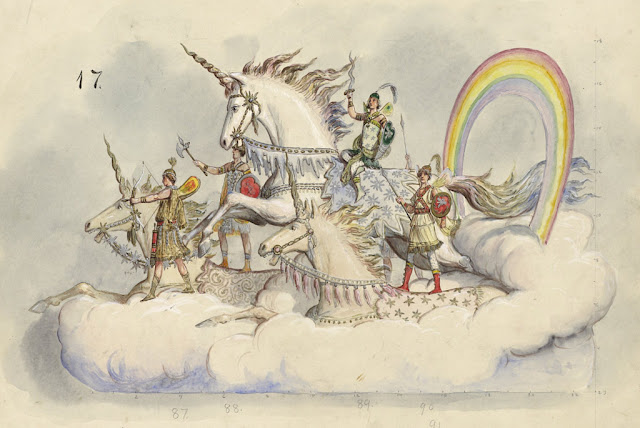


The Great Depression effectively ended this period of no-expense-spared Mardi Gras, yet its spirit of visual exuberance thrives into the twenty-first century. The papier-mâché, wood, paint, and maybe a few fake jewels, used to turn an ordinary person into a trickster devil or graceful half-human, half-butterfly, and a horse-drawn cart into a wonderland, endure in the spirit of Carnival creation.
As the annual bacchanalia of parades, processions, and parties continues in New Orleans, there are still threads to follow back to these artists who shaped fantasies into reality.
Subscribe to:
Comments (Atom)


MikeLiveira's Space on Tumblr