todo o material postado no blog pode ser encontrado na internet
Showing posts with label DRB. Show all posts

Awesome Car Hood Ornaments, Part Two

Awesome Car Hood Ornaments, Part Two:
"QUANTUM SHOT" #816

Link - article by Simon Rose and Avi Abrams


Chromed Streamlined Sculptures Designed to Inspire Motorists

There were just too many fascinating car hood ornaments for us to fit into our first article on this topic, so we simply had to take another look at these unique works of art. Ornaments were installed on the exposed radiator caps of cars in the early days of the motor vehicle and were still seen on hoods even when radiator caps ceased to be used. Here are some car hood ornaments from the past and present at Dark Roasted Blend.


(left: 1930 Packard 734 Speedster hood ornament; right: 1932 Auburn 12-160 Speedster; images credit: Jill Reger)


This beautiful golden bird decorates a 1912 Ford Model T Touring Car:


(image credit: Nick Young)


Here’s a radiator mascot from a 1927 Franklin Limousine (left). This figure on a 1928 Cadillac Town Sedan (right image) looks like it stepped straight out of the pages of Alice in Wonderland:


(images credit: T. W. Collins, Randy von Liski)


Here’s a nicely crafted flying quail radiator cap ornament on a 1930 Ford (left). And this one’s from a 1949 Ford Monarch (right):


(image credit: Randy von Liski, Sylvain Racicot)


These long-drawn faces were featured on Pontiac models from 1937:


(image credit: Librarianguish)


This ornament is on a 1953 Pontiac Chieftain:


(image credit: Stephen Brown)


Very 1950s Space Age chrome rocket hood ornament (and a badge) on the Oldsmobile Model 88, beautifully streamlined:


(image credit: William D. Hopkins)


This is also very intriguing 1958 Nash Metropolitan hood ornament which resembles a pilot riding on top of a chrome surf board:


(top image credit: William D. Hopkins, bottom images via)


There’s certainly been no shortage of animal-inspired decorations adorning the hoods of cars. Here we see a couple of horse and rider ornaments:


(images credit: FreakingNews, wilfy)


And more birds:


(images credit: Sandra Peppler /Pixel Pepp)


And then there’s this rather bizarre horned figure (seen on a Nash car):


(image credit: Steve King Photography)


Here we have a few inspired by human heads. The one on the left has another Native American design. Right image: this one appears to be a pilot or some other kind of aviator:


(images credit: Patti Pitzer, Rob Gale)


While this ornament seems to have been modeled on a man’s head from an old eighteenth century statue:


(image credit: Jeff Hanni)


Mythological creatures have also appeared many times as hood ornaments.


Photographer Jill Reger has plenty of enticing hood ornament images in her collection (see here). Here is the mythical creature on the 1929 Gardner Series 120 Eight-in-Line Roadster (left) and a winged figure on 1938 Cadillac V-16 convertible (on the right):


(images credit: Jill Reger)


On the left image below there is a really graceful Indian Maiden figure - and a beautiful Hispano-Suiza stork on the right:


(images credit: Jill Reger)


Fantasy, horror or even the paranormal have also served as the themes for ornaments for cars. How about these?... Gargoyles! -


(images credit: Jill Reger)


This is certainly a little strange:


(image credit: Jaime Carter)


And this one could be a ghost or a zombie or something else entirely:


(image credit: Monica Smoot)


This hood ornament certainly seem very pleased with himself (left)... and the skull ornament on the right is pretty cool, as well:


(images credit: Ken Morris Jr., Sandro Menzel)


This skull is very wisely wearing a sombrero in what appears to be very bright sunshine:


(image credit: Cherie Benoit)


How about this for creativity? A skeleton wearing what could almost be a bishop’s hat, holding a mug of frothing beer (left):


(images credit: William D. Hopkins)


And finally, if you don’t have a hood ornament on your vehicle like the ones featured in this article, why not just make your own? -


(image credit: Amy Stermer)


Article by Simon Rose and Avi Abrams, Dark Roasted Blend.


READ THE FIRST PART OF THIS ARTICLE! ->

Also check out our "AMAZING AUTOMOBILES" series ->

Marvelous Maps and Curious Cartography

From D.R.B. Quantum shot
Marvelous Maps and Curious Cartography, Part Three:
"QUANTUM SHOT" #817


"I have an existential map. It has 'You are here' written all over it." -- Steven Wright
Here’s another look at intriguing and sometimes bizarre maps here at Dark Roasted Blend. You can also check out Unusual and Marvelous Maps and Unusual and Marvelous Maps Part Two.

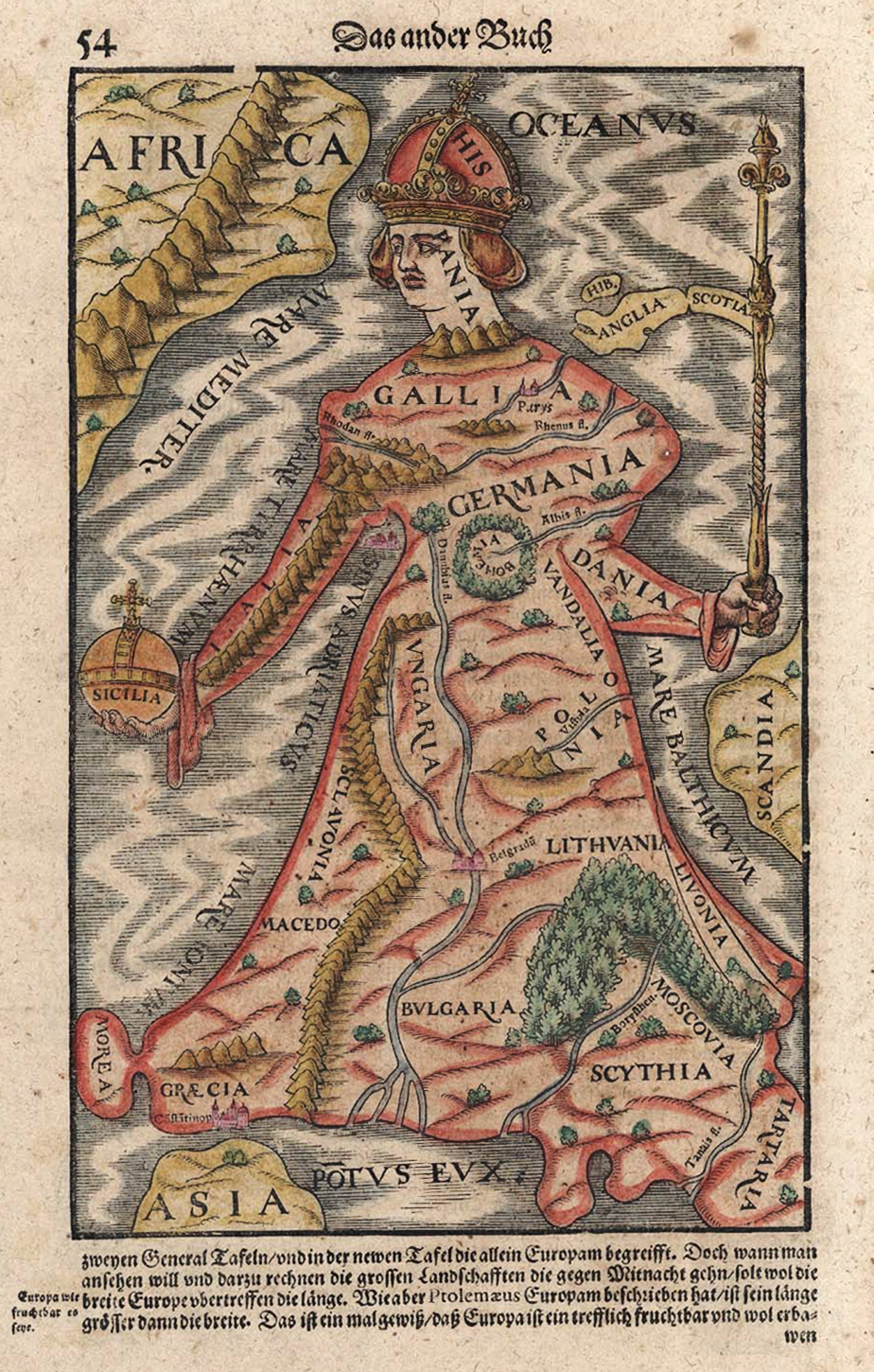
There have been lots of fanciful maps depicting countries as unusual characters. Here’s a 1570 map of Europe as a queen:


(image via)


These caricature maps of England and Scotland appeared in the 1790s:


(images credit: Yale University Library)


Here’s the Korean peninsular depicted as a tiger:


(left image via; on the right are antique prints via Museen Koeln)


And France is shown in the form of a sailing ship:


(image via)


Not quite a mythical kingdom, but this map shows a part of the world that certainly proved to be nonexistent as early explorers searched for the Northwest Passage:


(image via Princeton University Library)


Here we have the USA with each state defined by types of beer:


(images credit: Aleheads.com)


Speaking of tasty beverages, this map shows Europe’s three alcohol areas. The north is for distilled spirits and the south for wine, with beer in the middle:


(image via)


World War 1 served as inspiration for many map illustrators, as shown in these examples:


(images via, click to enlarge)


From the same era this map of an expanded Germany appeared in “Germany's Future” according to an officially circulated pamphlet published in early 1917:


(image credit: University of Texas, click to enlarge)


This one shows Germany’s plans for Africa in 1917:


(image credit: University of Texas)


Here are a couple of Cold War maps, showing the situation in Europe and Asia in the early 1950s:


(image credit: the Time Magazine issue of March 10, 1952, via)


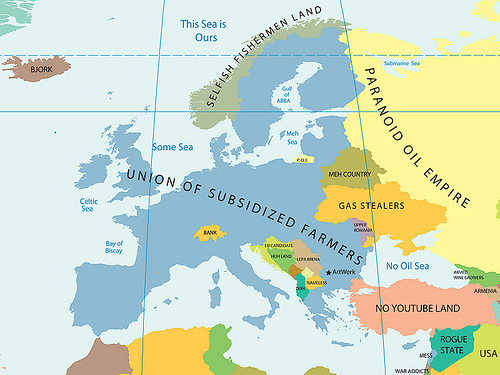
This is a somewhat amusing map of Europe:


(image via)


Never mind the European Union and the gradual erasing of national borders. How about this? This intriguing map of Europe designed by Freddy Heineken, the Dutch beer tycoon. It comprises small territories with more or less equal, ethnically homogenous populations of between 5 and 10 million. The general idea was that a greater number of smaller states would be easier to govern within a European union than a group of bigger competitive countries continually trying to dominate the group (you can see a list of Heinekin’s proposed countries here):


(image via)


This map shows a hypothetical Europe without Germany!.. There were a few similar plans to this at the close of World War II in 1945. Some were Nazi propaganda, but the Morgenthau plan to dismember Germany did exist and was seriously considered for a while. The Bakker-Schut Plan put together in the Netherlands at the end of the war proposed the annexation of parts of Germany, renaming of towns and cities, expulsion of the population and so on:


(images via 1, 2)

The right map above shows how the borders would have changed if the Allies had used the Morgenthau plan on Germany (drawn by Condottiero).


This very interesting map from 2007 concerns the Polish parliamentary elections. The overlay shows the border between the Russian and German Empires as it existed before World War I. Areas formerly part of Russia backed the conservative Prawo i Sprawiedliwość (“Law and Justice”) party, while those that used to be in Germany tended to support the right-wing liberal Platforma Obywatelska ("Civic Platform") party:


(image via)


An intriguing view of the United States, as seen from Japan apparently:


(image via)


Another US map, this one depicting gangland Chicago in 1931 (click here to zoom in):


(image credit: University of Illinois Library, via Chicago History Journal)


How about this map of the United Kingdom, featuring Brit Lit or all the major figures in literature over the last several hundred years? There’s even a place for Bram Stoker on the North Yorkshire coast near Whitby, which of course is one of the locations in the famous novel:


(image via Strange Maps)


Also on a literary theme, here’s a map all about book publishing. Countries are shown by the size of their domestic publishing markets. Europe, Asia and the USA are huge, indicating the strength of their publishing industries. In contrast, Africa and the Middle East hardly feature in the map, since the number of books published in those regions is very low compared to other areas of the globe:


(image via)


Another distorted map, this one showing a country’s size based on its population:


(image via)


And finally, on a similar theme, here we see how the map of the world would be transformed if the inhabitants of the countries with the largest populations moved to the countries with the largest geographic area. Interestingly, although China would take over Russia, Indonesia moves into China, Pakistan becomes Australia and Canada becomes India, the United States, Brazil and a few other countries stay where they are:


(image by JPalmz, based on Wiki info, via, click to enlarge)

Article by Simon Rose and Avi Abrams, Dark Roasted Blend.

READ PART TWO HERE ->
READ PART ONE HERE ->
Also read our HISTORY series ->

Monster Machinery Update from D.R.B.


Remember our coverage of the truly monstrous bucket wheel excavator eating a bulldozer? We also wrote about Humongous Tunnel Boring Machines (nothing "boring" about these "dinosaurs") and World's Most Powerful Mobile Crane. This time at Dark Roasted Blend, we again take a look at some of the largest vehicles and machines ever constructed.

This is the largest digging machine in the world. The bucket-wheeler excavator is called Bagger 288 or Excavator 288, built by Krupp of Germany. This thing’s over 300 feet high, more than 700 feet long machine and is the largest land vehicle in the world at 13,500 tons:


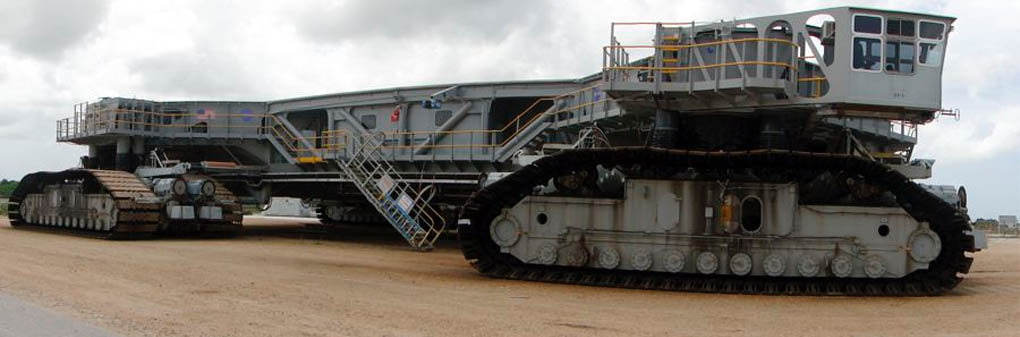
The Crawler-Transporter is a tracked vehicle used to transport such enormous objects as the Saturn V rocket and the Space Shuttle. These were the largest tracked vehicles in the world until they were overtaken by the Bagger 288 excavator:


(images credit: Mischa Klement, MicroArtwork, Austria, MicroArtwork.com)


The TAKRAF RB293 is a German made giant bucket-wheel excavator. Used in mining operations in Australia, it is recognized as the largest and heaviest land vehicle:


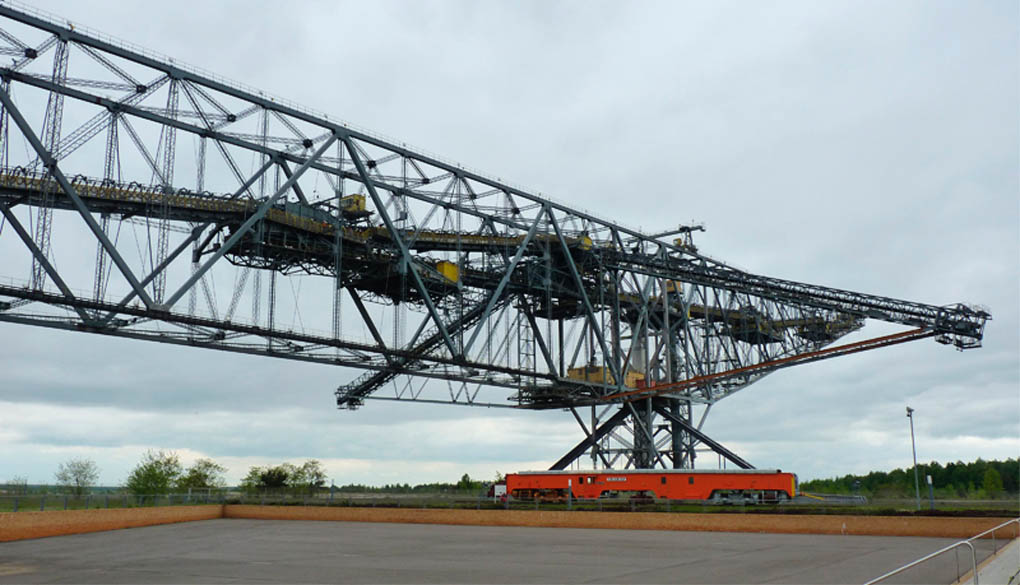
The F60 is apparently the world's largest machine that can move. The cutting height is 60 meters, hence the name and at 502 meters long, this has been called the ‘lying Eiffel Tower’. This machinery is used in Germany for brown coal or lignite opencast mining:


(image credit: Gwilym Owen)

This gigantic machinery is used for placing enormous windmills in the North Sea:


(image credit: Tjeert. M)


This is the world’s biggest tunnel boring machine – 400 feet long, 51 feet in diameter and weighing 9.5 million pounds (left image below). The tunnel machine on the right was used to construct underground sections of the transit lines in Toronto:


(images via 1, 2)

While this one was used for transit tunnels in Seattle:


(image credit: Keith Seinfeld, KPLU)


The monstrous Liebherr T 282B is a large earth-hauling dump truck designed in Germany in 2004.
it became the biggest earth-hauling truck in the world, with the most advanced model driven by a 10.5 ton, 3650 hp, 90 liter diesel engine:


(image via)


Also by Liebherr, this extremely heavy duty hydraulic shovel is used in open pit mining:


(image via Power Step, under permission)


(image via)

This colossal machine called The Captain was built in 1965 and was the world’s largest power shovel, until it was scrapped in 1992. The bucket could hold 300 tons of material and at 28 million lbs this was the heaviest land vehicle ever built and one of the two largest land-based mobile machines ever constructed:

(image via)


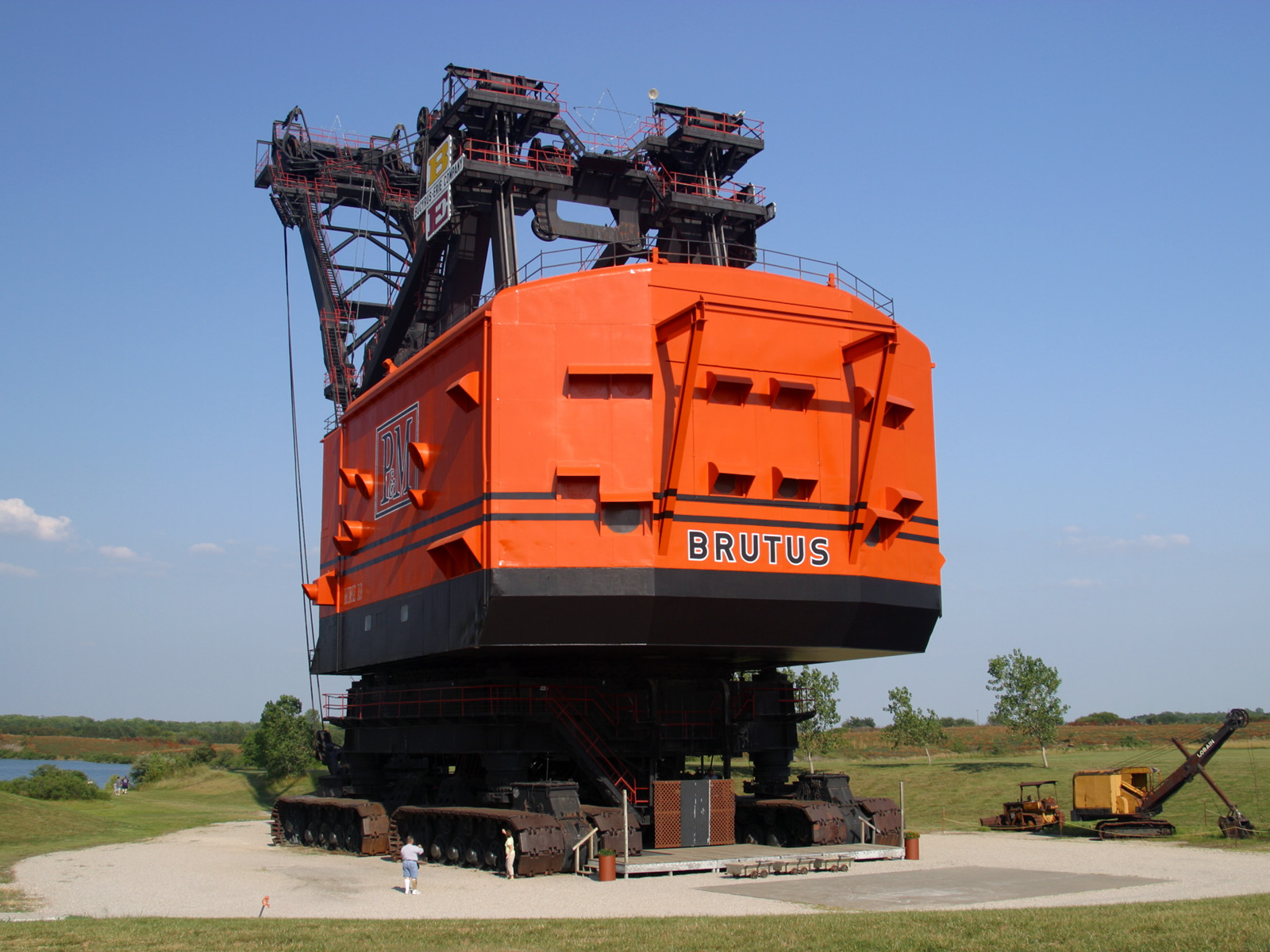
The Bucyrus-Erie 1850B, built in 1962 at a cost of $6.5 million, is also known as Big Brutus, and it certainly is big. 160 feet tall and weighing 11 million lbs, the bucket could carry 150 tons of material and not surprisingly the machine had a maximum speed of just 0.22 mph. This machine isn’t the largest electric shovel ever built, but it is the largest electric shovel still in existence. Big Brutus was in operation in the sixties and seventies and is now on display at a mining museum in West Mineral, Kansas:


(images credit: Dale, 2)


The Big Bud 747 or 16-V 747 is the world’s largest farm tractor, weighing 100,000 lbs. This agricultural monster is 27 feet long, 20 feet wide and 14 feet high. It only travels at 8 mph, but is capable of cultivating 60 acres in an hour:


(images via 1, 2)


Here are some gigantic floating cranes in Japan - make sure to see our article Giant Floating Crane lifts Bridges:


(image via)


The 4200 SM surface miner developed by Wirtgen of Germany weighs over 200 tonnes, is more than 30 m long and can cut up to 3,000 tonnes of material in an hour:


(image via)


And finally, here’s the Large Hadron Collider (LHC), the biggest and highest-energy particle accelerator in the world, designed to collide opposing particle beams. Constructed by the European Organization for Nuclear Research (CERN) and involving 10,000 engineers and scientists from universities and laboratories in more than 100 countries, the Collider is located underground on the France-Switzerland border near Geneva.


(images courtesy CERN, via)


Traduzir para ChinêsTraduzir para Espanholtraduzir para françêstraduzir para inglêstraduzir para alemãotraduzir para japonêsTraduzir para Russo


MikeLiveira's Space on Tumblr