todo o material postado no blog pode ser encontrado na internet
Showing posts with label martial_arts. Show all posts

Aiki-jujutsu (Daito Ryu)


Daitō-ryū Aiki-jūjutsu, is a Japanese martial art that first became widely known in the early 20th century under the headmastership of Takeda Sokaku. Takeda had extensive training in several martial arts (including Kashima Shinden Jikishinkage-ryū and sumo) and referred to the style he taught as “Daitō-ryū” (literally, “Great Eastern School”).
the wrapping of hands for safety reasons before training / or actual combat or sparring


Although the school’s traditions claim to extend back centuries in Japanese history there are no known extant records regarding the ryū before Takeda. Whether Takeda is regarded as either the restorer or the founder of the art, the known history of Daitō-ryū begins with him. Takeda’s most well known student was Morihei Ueshiba, the founder of aikido.

[From Wikipedia. More here]

Krav Maga

Krav Maga (/krɑːv məˈɡɑː/; lit. "contact-combat") is a self-defense system developed for the Israel Defense Forces (IDF) that consists of a wide combination of techniques sourced from aikido, judo, boxing and wrestling, along with realistic fight training. Krav Maga is known for its focus on real-life situations and its extremely efficient, and brutal counter-attacks. It was derived from street-fighting skills developed by Hungarian-Israeli martial artist Imi Lichtenfeld, who made use of his training as a boxer and wrestler as a means of defending the Jewish quarter against fascist groups in Bratislava, Czechoslovakia in the mid-to-late 1930s. In the late 1940s, following his migration to Israel, he began to provide lessons on combat training to what was to become the IDF, who went on to develop the system that became known as Krav Maga. It has since been refined for civilian, police and military applications.

Krav Maga practitioners of note include actors Cam Gigandet, Kristanna Loken, and Jansen Panettiere.

Krav Maga has a philosophy emphasizing aggression, neutralization, and simultaneous defensive and offensive maneuvers. Krav Maga has been used mainly by the Israel Defense Forces' special units and reconnaissance brigades and recently by regular infantry brigades, and several closely related variations have been developed and adopted by law enforcement and intelligence organizations, Mossad and Shin Bet. There are several organizations teaching variations of Krav Maga internationally.

קרב מגע


Krav Maga encourages students to avoid confrontation. If this is impossible or unsafe, it promotes finishing a fight as quickly as possible. Attacks are aimed at the most vulnerable parts of the body, and training is not limited to techniques that avoid severe injury; some even permanently injure or cause death to the opponent. Drills provide maximum safety to students by the use of protective equipment and the use of reasonable force.

Students learn to defend against all variety of attacks and are taught to counter in the quickest and most efficient way.

Ideas in Krav Maga include:
  • Counterattacking as soon as possible (or attacking preemptively).
  • Targeting attacks to the body's most vulnerable points, such as: the eyes, neck or throat, face, solar plexus, groin, ribs, knee, foot, fingers, liver, etc.
  • Maximum effectiveness and efficiency in order to neutralize the opponent as quickly as possible.
  • Simultaneous attack and defence
  • Maintaining awareness of surroundings while dealing with the threat in order to look for escape routes, further attackers, objects that could be used to defend or help attack, and so on.

Training can also cover the study and development of situational awareness to develop an understanding of one's surroundings, learning to understand the psychology of a street confrontation, and identifying potential threats before an attack occurs. It may also cover ways to deal with physical and verbal methods to avoid violence whenever possible.


Glima


Glíma is the name of the Scandinavian martial arts system used by the Vikings. The word glíma in Old Norse means glimpse or flash, which describes the systems techniques.

Glima as a self-defence system contains throws, blows, kicks, chokes, locks, pain techniques and weapon techniques, and is comparable with the best complete martial arts systems from around the world. Glima as self-defence was the foundation for the Viking warrior, and these techniques are still practiced in Scandinavia, Europe, North America and South America.

Glima as a sport covers several types of Scandinavian folk wrestling: Lausatök, Hryggspenna, and Brokartök. Glima was the most widespread sport in the Viking Age, and was practiced by men and women of all ages. Wherever Vikings gathered, Glima was a big part of the entertainment. Glima was so important for Viking society that their most popular god, Thor, was also the Viking god of wrestling.

Glima is first mentioned in Viking poetry by the Norwegian court poet Bragi Boddason (790-850) and Kveldúlfr Bjálfason (820-878), also of Norwegian Heritage. The poetry is about the Norse god Thor and his journey to Utgards-Loki, where Elli defeats Thor in a wrestling match.

Glima is also mentioned in Prose Edda the Icelandic collection of texts from 1220, and in the book Gylfaginning.


History of Glíma

The Vikings were famous as great warriors, on land and at sea. Viking warriors had the skills to survive against the various forms of warfare they encountered in their travels around the world.
The reason for the Vikings fighting prowess is found in the way they trained both with, and without weapons. Glima training for Scandinavian children began at 6 or 7 years of age. 
The combat system of Glima developed the strength, reflexes, endurance and courage, Viking warriors needed to survive in battle. Glima as a sport was fun, and Glima wrestling competitions were extremely popular.

As with people of every age and nationality, Vikings loved sports. Wrestling was the most widespread sport in the Viking Age, and there were several variants. Viking wrestling was divided into glima wrestling, Råbryting (Raw wrestling) and water wrestling. 
The unrestricted form of Råbryting was crude and wild and differed from glima wrestling because these contests were decided by opponents being pinned down. Water wrestling was a wrestling match in the water, and was the most popular form of swimming competition. 
The idea was to keep the opponents head under water until he gave up, and such matches could last for hours. 
The skilled variants of Glíma wrestling (Brokartök, Hryggspenna, and Lausatök) had complex rules and competitors brought each other down with lightening quick moves and tricks as much with the feet as with the hands. Glima wrestling was divided into several classes based on strength and skill, between two opponents or team competitions between different districts.

The original Norwegian settlers in Iceland took Viking wrestling and the Glima combat systems with them, according to the Jónsbók law book from 1325. In the Icelandic medieval book of laws known as Grágás, which refers to a collection of earlier Norwegian laws, there were rules for wrestling. The Icelandic populace has taken very good care of their Norwegian heritage, and Glima there is almost unchanged since Viking times.

Brokartök Glíma is the national sport of Iceland. The oldest Icelandic competition in glima is Skjaldarglíma Ármann which was first held in 1888 and has been held almost every year since. In 1905 the belt was introduced so that the wrestlers could have a better grip on each other. Before that they held on each other's trousers. In 1906 the first Íslandsglíman (Grettisbeltið) competition was held where the winners are named Glímukóngur.

In the 1912 Summer Olympics there was a demonstration of glima, it was an introduction of the sport to the world, and a reintroduction to Scandinavia. Olympic officials had consented to making Glima an official Olympic sport, the Olympic committee planned to fulfill the promise and include glíma at the Olympics in Antwerpen 1920. When the participation of Icelandic glíma-wrestlers had been secured, news were received that the Danish king planned to visit Iceland that same summer. 
The sports leadership decided that it was more important to offer the king a spectacle of the best wrestlers. Icelandic sport officials cancelled their participation in the Olympics. 
Eventually, the king postponed his journey and did not visit Iceland until a year later.

In the final chapter of the 20th century, Glima began to be practiced in mainland Scandinavia.

In 1987 glima was taught in primary school in Iceland.


Vovinam aka Việt Võ Đạo


Vovinam is practiced with and without weapons. It is based on the principle of between hard and soft. It includes training of the body as well as the mind. It uses force and reaction of the opponent. Vovinam also includes hand, elbow, kicks, escape- and levering techniques. Both attack and defense techniques are trained, as well as forms, combat and traditionalwrestling. The wide range of techniques include punching, kicking, forms, wrestling, sword, staff, axe, folding fan and others.

Self-defense techniques cover defense against weaponless attacks like choking from behind and defense against attacks with knife or sword. Advanced students learn to combine the techniques and learn to defend themselves against armed opponents. Instructors train traditional weapons like the long stick, short stick, knife, sword and sabre. Thereby the weapons serve as training devices for reaching optimal control of body and mind.

V

History
Vovinam Việt Võ Đạo was founded as Vovinam by Nguyễn Lộc (1912 – 1960) in 1938, with the intent of providing practitioners with an efficient method of self-defense after a short period of study. Nguyễn believed martial arts would contribute to freeing Vietnam, which had been ruled by France since 1859, from outside domination. Vovinam, which Nguyễn synthesized from Chinese styles of kung fu, his own knowledge of traditional Vietnamese martial arts, and elements of Japanese and Korean systems, was thus created partially as a response to the French occupation, meant to promote a sense of national identity for the Vietnamese people.

After being invited to demonstrate Vovinam publicly in Hanoi with his disciples in 1940, 
Nguyễn was invited to teach the art at Hanoi's Ecole Normale, and Vovinam gained in popularity. During the following years, political unrest increased throughout Vietnam; due to the system's nationalist political orientation, the art came under suppression. By 1954, Nguyễn had emigrated to South Vietnam, where he was able to continue to teach and establish Vovinam schools. After his death in 1960, Grandmaster Le Sang continued the development and international promotion of Vovinam until his own death on September 27, 2010.

The first Vovinam school outside of Vietnam was established in Houston, Texas, by Vietnamese emigrants in 1976, after the Fall of Saigon. By 2000, Vovinam schools had been established in Australia, Belgium, Canada, France, Germany, Italy, Morocco, Poland, Spain, Switzerland, and the United States. Vovinam now exists as Vovinam Việt Võ Đạo, without the political overtones it originally carried.


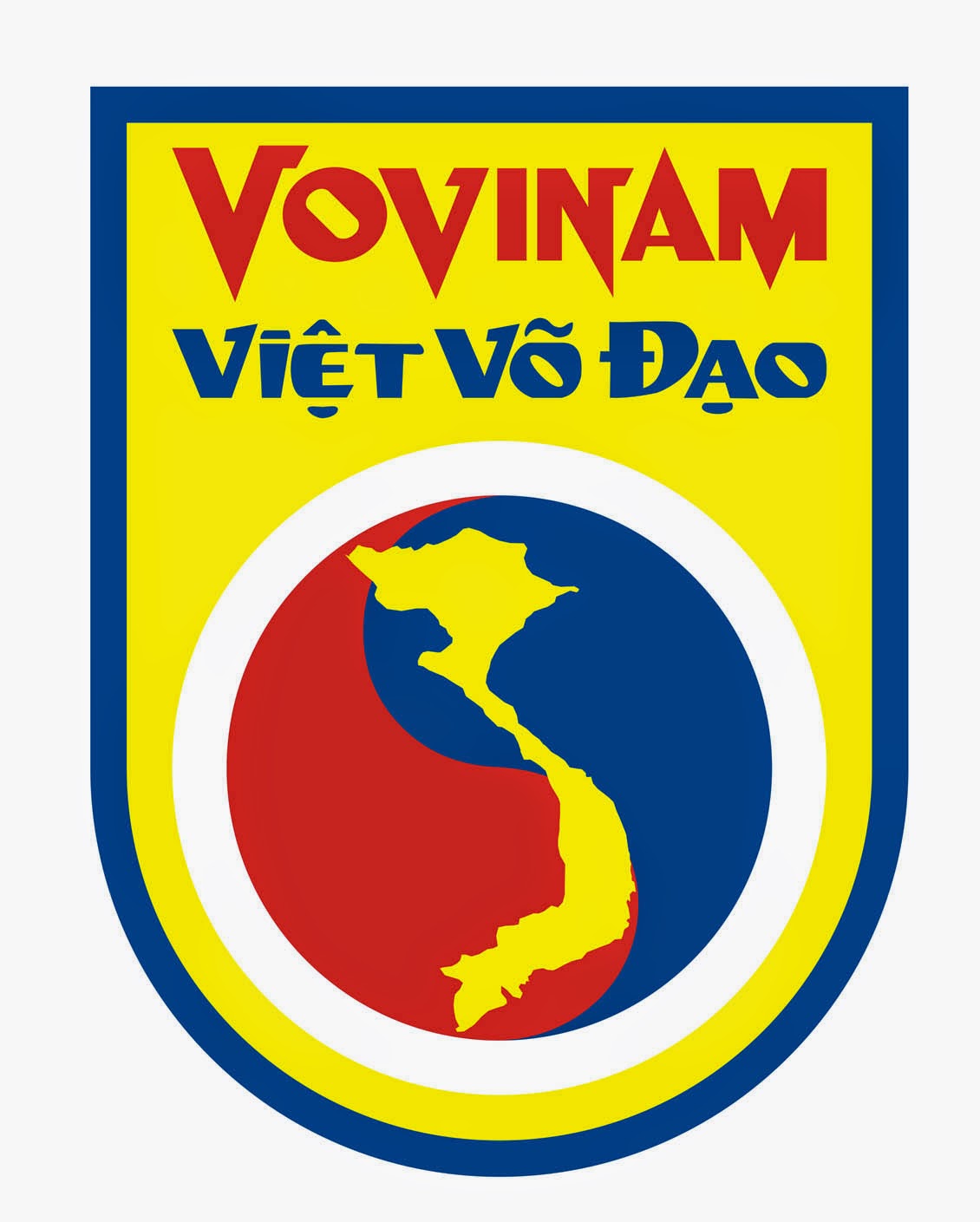
Logo
The Vovinam Việt Võ Đạo logo is framed in a yellow shape composed of a rectangle conjoined with a circle, angular at the top, round at the bottom.


This shape symbolizes the perfection of the hard and soft.
Within this yellow shape, the red text "Vovinam" is written above the marine blue text "Việt Võ Đạo". Beneath the text appears a yin-yang symbol in red and marine blue. The yin-yang symbol is surrounded by a thick, white circle, symbolizing the being of the Dao, with the mission to mediate between yin and yang, to subdue the two, to enable life of all beings.
 A yellow map of Vietnam is superimposed on the yin-yang symbol.


Belt System
This is the Unique belt System For Vovinam. It is not like taekwondo where at the end is a black belt. Also the belts aren't random colors they have meaning with them. 
(For Example the Blue's meaning is hope)


The student begins with a light blue belt - the same color as his/her suit.
Blue vovinam 16x16.png
Blue stands for the factor of the sea, and the hope - the hope in being successful in learning Vovinam.
With the following 3 exams yellow stripes are added to the blue belt. The 3rd yellow stripe is followed by the yellow belt.
Yellow vovinam 16x16.png
Yellow It symbolically stands for the skin color of Asian people. It symbolizes the "skin deep" internalization of the martial art and the philosophy.
In other martial arts this belt is black. Therefore, a Vovinam student who carries a yellow belt is allowed to carry a black belt. This makes a comparison to other martial arts easier, e.g. in public performances. A person who wears a yellow belt with one or more stripes is considered an instructor.
Following in a longer period of time, respectively 3 red stripes are added to the yellow belt. This corresponds to the 1st, 2nd, respectively 3rd degree blackbelt (Đẳng). The exam following the 3rd red stripe is the master's exam. Passing the exam successfully assigns the right to wear a red belt with a circulating yellow border (4th degree blackbelt).
Red vovinam 16x16.png
Red stands for the blood and the intensive flame. The student has internalized Vovinam (Việt Võ Đạo) even further.
The 5th to 10th degree blackbelt are shown as a completed red belt with 1 to 6 white stripes.
White vovinam 16x16.png
White stands for the infiniteness, the bones; is the symbol of the depth of the spirit. The white belt assigns the master the absolute mastery of Vovinam Việt Võ Đạo.

Vietnamese martial art of Vovinam.

The Sword And The Sorcerer GIF

Morihei Ueshiba

Morihei Ueshiba was born on December 14 1883 in a village of the province of Wakayama, south of Osaka (Japan). He was short (158 cm) and still a frail teenager when he briefly studied Jujutsu at the age of 17 at the Kito School (Tokusaburo Tosawa) in Tokyo.
In 1903, at the onset of the war between Russia and Japan he enlists in the infantry. Discharged a few years later he studies fencing at the Yagyu School in Sakai (near Osaka) and granted a certificate in 1908.

In 1910, he leaves with a group of settlers for Hokkaido, the big Island to the north of the Japanese archipelago. He encounters Sokaku Takeda, a renowned master of Daito Jiu-jitsu and becomes his student. He is initiated to the secrets of the sect and more so to the essence of budo. He becomes a certified instructor in 1916. In 1918 shortly before his father¿s death, he encounters Degushi Onisaburo, founder of a Shinto sect and a dedicated pacifist who will become his spiritual leader. He turns to meditation and prayers while still teaching Budo. This is the awakening of a long spiritual quest.


In 1925 he experiences a first revelation: «I understood, Budo is not felling the opponent by our force; nor is it a tool to lead the world into destruction with arms. True Budo is to accept the spirit of the universe, keep the peace of the world, correctly produce, protect and cultivate all beings in nature “» In 1927 he moves to Tokyo and opens a Budo school. He has developed an exceptional strength which enables him to defy any adversary despite his small size. The reputation of his school spreads fast. Other grand masters like Jigoro Gano, founder of Judo, send their advanced students to complement their training. He chooses his students from the elite of the army, the navy and the police and the Japanese high society. Around 1942 Morihei Ueshiba¿s teaching is officially named Aikido. Those are tough times. Japan is at war and in 1942 he puts his son in charge of an almost deserted central dojo and leaves Tokyo for farmlands. He builds an open sky dojo where he spends the next 10 years perfecting his art.


After the war Aikido opens up to all. It expands rapidly in Japan first then, starting in the mid fifties in Asia, Hawaii and later in the western world with the dispatching of permanent instructors abroad. On April 26, 1969 the Great Master passed away. He was 86. His son Kisshomaru succeeded him until his death in 1999 and his great grand son Moriteru thereafter.

Traduzir para ChinêsTraduzir para Espanholtraduzir para françêstraduzir para inglêstraduzir para alemãotraduzir para japonêsTraduzir para Russo


MikeLiveira's Space on Tumblr