todo o material postado no blog pode ser encontrado na internet
Showing posts with label myths and legends. Show all posts

Kalevala

The Kalevala is a 19th-century work of epic poetry compiled by Elias Lönnrot from Karelian and Finnish oral folklore and mythology.

It is regarded as the national epic of Karelia and Finland and is one of the most significant works of Finnish literature. The Kalevala was instrumental in the development of the Finnish national identity, the intensification of Finland's language strife and the growing sense of nationality that ultimately led to Finland's independence from Russia in 1917.

The first version of The Kalevala (called The Old Kalevala) was published in 1835. The version most commonly known today was first published in 1849 and consists of 22,795 verses, divided into fifty songs (Finnish: runot). The title can be interpreted as "The Land of Kaleva" or "Kalevia".


The story

The Kalevala begins with the traditional Finnish creation myth, leading into stories of the creation of the earth, plants, creatures and the sky. Creation, healing, combat and internal story telling are often accomplished by the character(s) involved singing of their exploits or desires. Many parts of the stories involve a character hunting or requesting lyrics (spells) to acquire some skill, such as boat-building or the mastery of iron making.

As well as magical spell casting and singing, there are many stories of lust, romance, kidnapping and seduction. The protagonists of the stories often have to accomplish feats that are unreasonable or impossible which they often fail to achieve leading to tragedy and humiliation.

The Sampo is a pivotal element of the whole work. Many actions and their consequences are caused by the Sampo itself or a character's interaction with the Sampo. It is described as a magical talisman or device that brings its possessor great fortune and prosperity, but its precise nature has been the subject of debate to the present day.

There are also similarities with mythology and folklore from other cultures, for example the Kullervo character and his story bearing some likeness to the Greek Oedipus. The similarity of the virginal maiden Marjatta to the Christian Virgin Mary is also striking. The arrival of Marjatta's son in the final song spelling the end of Väinämöinen's reign over Kalevala is similar to the arrival of Christianity bringing about the end of Paganism in Finland and Europe at large.


The Kalevala
translated by John Martin Crawford
[1888]

O Livro De Urântia

Revelando os mistérios de deus, do universo, de jesus e sobre nós mesmos
O Livro de Urântia é uma obra narrativa a qual integra elementos de história, ciência, filosofia e religião para revelar a verdade universal para os seres humanos que habitam o planeta Terra, chamado no livro de esfera "Urântia".

A obra é composta por 197 documentos escritos originalmente em inglês e traduzidos recentemente para outros idiomas, entre eles o português.
O Livro de Urântia é uma revelação divina cuja origem se vai desvendando em simultâneo com o processo de leitura. Esta obra única, que irá sem dúvida marcar os habitantes deste planeta, descreve a totalidade da criação, desde o infinito passado até ao infinito futuro, oferecendo ao presente um sentido grandioso, inteligente e exaltante. O Livro de Urântia revela a Divindade, a organização e a administração dos universos, as relações do nosso planeta (Urântia) com estes universos, bem como o destino do homem na sua ligação com Deus, descrevendo ainda, pormenorizadamente, a vida e os ensinamentos de Jesus. Trata-se de um livro que se dirige às mais profundas aspirações espirituais do homem, satisfazendo assim o seu intelecto. Através da criação de uma harmonia absoluta entre religião, filosofia e ciência, e promovendo uma religião e uma cosmologia proporcionais ao desenvolvimento intelectual e cultural do homem, este livro confere ao conceito de destino humano uma dimensão inigualável. Ao longo de 197 capítulos, O Livro de Urântia revela um discurso inovador, compreensível e organizado sobre as origens, a história e o destino do homem, levando-o assim a conhecer-se melhor, a compreender o seu tempo e a concretizar o seu objectivo na terra: preparar-se, através do conhecimento da alma, para a eternidade.
O Livro de Urântia é composto por 197 documentos, que se diz terem sido entregues entre 1928 e 1934 a um grupo de 70 pessoas, em Chicago, Illinois, Estados Unidos. Os autores que escreveram esses documentos têm seus nomes indicados no livro, junto com seus respectivos escritos. Os seres humanos aos quais os escritos foram entregues em mãos já faleceram e o modo pelo qual os escritos foram materializados ainda não foi plenamente explicado e dificilmente o será.

Liv_urant_pt.pdf - 5.9 MB

Macuahuitl: The Aztec “Obsidian Chainsaw” Even More Fearsome Than It Sounds

By William DeLong

The macuahuitl was plenty deadly enough to take you down. But the Aztecs would rather bring you to the edge of death, then sacrifice you alive.
Little is known for sure about the macuahuitl, but we do know is positively terrifying. For starters, it was a thick, three- or four-foot wooden club spiked with a number of blades made from obsidian, said to be even sharper than steel.

This “obsidian chainsaw,” as it’s often now called, was likely the most feared weapon wielded by Aztec warriors both before and during the era of Spanish conquest in Mesoamerica starting in the 15th century. In fact, when the invading Spanish found themselves up against macuahuitl-wielding Aztec warriors, they did well to keep their distance — and with good reason.
Horrifying Tales

Anyone felled by a macuahuitl endured extreme pain that brought them agonizingly close to the sweet release of death before being dragged off to a ceremonial human sacrifice.
And anyone who encountered a macuahuitl and lived to tell about it reported horrifying tales.

Spanish soldiers told their superiors that the macuahuitl was powerful enough to decapitate not only a human, but also his horse. Written accounts say that a horse’s head would dangle by a flap of skin and nothing else after coming in contact with a macuahuitl.

According to one account from 1519 given by a companion of conquistador Hernán Cortés:

“They have swords of this kind — of wood made like a two-handed sword, but with the hilt not so long; about three fingers in breadth. The edges are grooved, and in the grooves they insert stone knives, that cut like a Toledo blade. I saw one day an Indian fighting with a mounted man, and the Indian gave the horse of his antagonist such a blow in the breast that he opened it to the entrails, and it fell dead on the spot. And the same day I saw another Indian give another horse a blow in the neck, that stretched it dead at his feet.”
The macuahuitl was not just an Aztec invention. Many of the Mesoamerican civilizations in Mexico and Central America used obsidian chainsaws on a regular basis. Tribes frequently fought each other, and they needed prisoners of war to appease their gods. Hence, the macuahuitl was a blunt-force weapon as well as one that could severely maim someone without killing them.

Whichever group wielded it, the macuahuitl was so powerful that some accounts claim that even Christopher Columbus was so impressed with its strength that he brought one back to Spain for display and testing.

The Design And Purpose Of The Macuahuitl


Mexican archaeologist Alfonso A. Garduño Arzave conducted experiments in 2009 to see if the legendary accounts were true. His results largely confirmed the legends, starting with his finding that the macuahuitl had two primary — and very brutal — purposes based on its design.

First, the weapon resembled a cricket bat in that the bulk of it consisted of a flat, wooden paddle with a handle on one end. The blunt portions of a macuahuitl could knock someone unconscious. This would allow Aztec warriors to then drag the unlucky victim back for a ceremonial human sacrifice to their gods.

Second, the flat edges of each macuahuitl contained anywhere from four to eight razor-sharp pieces of volcanic obsidian. The obsidian pieces could be several inches long or they could be shaped into smaller teeth that would make them appear like chainsaw blades. On the other hand, some models also had one continuous edge of obsidian stretching from one side to the other.

When chiseled to a fine edge, obsidian has better cutting and slicing properties than glass. And when using these blades, warriors could make a circular, slashing motion with a macuahuitl to easily cut open someone’s skin at any vulnerable point on the body, including where the arm meets the chest, along the legs, or at the neck.


How the Mythological Tale of Orpheus and Eurydice Has Been Reinterpreted Through Music

by Lori Dorn


YouTuber Polyphonic, who creates incredibly informative video essays about music took a historical look at the classic mythological tale of lovers Orpheus and Eurydice, noting how that very same story has been interpreted very differently by artists throughout the ages.

It’s easy to see why contemporary musicians have latched on to this myth. The tragedy is beautiful and every musician sees a part of Orpheus within themselves.

Enûma Eliš o mito da criação babilónico

O Enuma Elish é um poema épico da antiga Babilónia sobre o mito da criação, escrito em sete tábuas de argila e descobertas no século XIX por Austen Henry Layard, nas ruínas da Biblioteca de Assurbanípa, em Nínive, próximo da actual cidade de Mossul no Iraque.
Este épico é uma das fontes mais importantes para a compreensão da visão cósmica babilónica, centrada na supremacia de Marduque e da criação da humanidade para o serviço dos deuses e data, provavelmente, do século XII a.C., podendo reflectir ideias anteriores, provenientes da civilização sumeria.
Era recitado no quarto dia do festival de ano novo da Babilónia. O nome Enuma Elish foi retirado das primeiras palavras do poema e significa "Quando no alto".


O Enûma Eliš possui várias cópias na Babilônia e Assíria. A versão da Biblioteca de Assurbanípal data do século VII a.C. A composição do texto, provavelmente, remonta a Idade do Bronze, nos tempos de Hamurabi ou talvez o início da era cassita (cerca de século XVIII a XVI a.C.), embora alguns estudiosos favoreçam uma data posterior a 1100 a.C.

Dadas as suas enormes semelhanças com a narração bíblica do Génesis, várias discussões têm surgido sobre qual das histórias é a original e qual é uma adaptação à religião em causa. Para a cultura babilónica, o Enuma Elish explica a origem do poder real, a sua natureza, a permanência da instituição e a sua legitimidade. A realeza humana e terrena tem a sua origem na realeza divina.
A divindade continuará a ser o verdadeiro rei e também o modelo a imitar pelo rei terreno.
A existência de um modelo divino impõe limites à realeza humana.

Apesar do estado de degradação, de grande parte da 5ª tábua nunca ter sido recuperada e de divergências na tradução e interpretação, o texto está quase totalmente disponível.
Dadas as suas enormes semelhanças com a narração bíblica do Génesis, várias discussões têm surgido sobre qual das histórias é a original e qual é uma adaptação à religião em causa.
Para a cultura babilônica, o Enuma Elish explica a origem do poder real, a sua natureza, a permanência da instituição e a sua legitimidade.
A realeza humana e terrena tem a sua origem na realeza divina. A divindade continuará a ser o verdadeiro rei e também o modelo a imitar pelo rei terreno. 
A existência de um modelo divino impõe limites à realeza humana.


versão em portugues: Enuma E pt.pdf - 434 KB

Ancient Greek Vase Artists Painted Images of Biblical Figures Noah and Nimrod Over 2,000 Years Ago


The Book of Genesis describes human history. Ancient Greek religious art depicts human history. While their viewpoints are opposite, the recounted events and characters match each other in convincing detail. This brief article focuses on how Greek religious art portrayed Noah, and how it portrayed Nimrod in his successful rebellion against Noah’s authority.

As I point out in my new full-color book, Genesis Characters and Events in Ancient Greek Art, and here, neither Noah nor Nimrod is depicted incidentally or casually. Both characters are crucial to the expressed boast of Zeus-religion: The way of Cain—the exaltation of mankind as the measure of all things—has triumphed over Noah and his God-fearing offspring in the post-Flood world; God’s way is forgotten and the ancient serpent’s “enlightenment” from the ancient garden paradise is welcomed. See: Garden of Eden Depicted in Ancient Greek Religious Art

Unless otherwise noted, the paintings and sculptures date from about 440 to 460 BC. Astounding is not a strong enough word for what is presented here: Painted and sculpted images of Noah and Nimrod from two and a half millennia ago!

It should be front page news, but as it does not fit within the ruling evolutionist paradigm, it will most likely be ignored. Let’s see what happens. 


Nereus—The Greek Noah


The Greeks knew exactly who Noah was. They called him Nereus, the “Wet One,” and Halios Geron, the “Salt-Sea Old Man.” Above, we see three different depictions of Nereus from ancient Greek vases. On all three he looks very old, he is seated as if on a throne, and he holds a scepter, a symbol of rule. The simple artistic communication: Here is the old man who ruled.Genesis 6:9 speaks highly of Noah’s character: “Noah is a just man. Flawless became he in his generations. With God walks Noah.”The ancient Greek poet Hesiod says essentially the same thing about Nereus: “But Pontos, the great sea, was father of truthful Nereus who tells no lies, eldest of his sons. They call him the Old Gentleman because he is trustworthy, and gentle, and never forgetful of what is right, but the thoughts of his mind are mild and righteous”(Theogony 233).
Note that Hesiod describes Nereus as the great sea’s eldest son; that is, the eldest of those who came through the Flood.The Book of Genesis does not name Noah’s wife, but the Greeks said that the wife of Nereus was the Oceanid Doris. What made her an Oceanid was the fact that she rode the ocean in the ark with Noah/Nereus and their family for nearly a year.
Greek artists chronicled the rise of their God-rejecting and serpent-exalting religion from Noah’s lifetime, and often depicted Noah/Nereus with the bottom half of a fish and/or holding a fish, signifying that this is the fish-man who brought humanity through the Flood. 


Herakles—The Greek Nimrod

The Greeks knew exactly who Nimrod was as well. Many of us have read of Nimrod as “a mighty warrior on the earth” and a “mighty hunter” (Genesis 10:8-9). Herakles is a title or epithet. His real name in Greek was Alcaeus meaning “mighty one.”

Just as Nimrod is the greatest hunter and warrior of the post-Flood world in Genesis, so Herakles is the greatest hunter and warrior in Greek religious art. Herakles is the Nimrod of Genesis, exalted as a great hero and transported to Greek soil.
After the Flood, God instructed mankind to be “fruitful and increase and fill the earth and subdue it” (Genesis 9:1). That included subjecting every living animal of the earth, all the fishes of the sea, and every flyer of the heavens (Genesis 9:2-3). Greek art portrayed Herakles as the “master hunter” doing exactly that in the post-Flood world.


Read full article at:

WEIRD MONSTERS OF JAPANESE FOLKLORE

There’s an ancient Japanese legend of the one hundred yōkai—monsters, ghosts, apparitions and demons—who parade through the streets on hot summer nights. If anyone is unfortunate to see these creatures—or to be caught up in it—then they will perish away or worse be taken captive for the twisted pleasure.
If you’ve ever watched the enjoyable trilogy of movies Yokai Monsters—One Hundred Monsters (1968), Spook Warfare (1968), and Along With Ghosts (1969)—then you’ll have a good idea what these demons look like—ogres, goblins, ghosts, sprites, spooky umbrellas and dangerous women with ever-extending serpentine necks.

All of these incredible monsters have long been a part of Japanese folklore. They were first codified in the supernatural bestiary—Gazu Hyakki Yagyō (The Illustrated Night Parade of a Hundred Demons) by artist and scholar Toriyama Sekien in 1776. It’s a kind of fabulously illustrated Fantastic Beasts and Where to Find Them but far, far more beautiful and eerie.

In 1881, artist Nabeta Gyokuei updated this incredible volume when he produced a picture book or e-hon of Sekien’s 100 demons. The Kaibutsu Ehon or Illustrated Book of Monsters features beautiful woodblock prints of each of the yōkai and its special powers.

The whole book can be viewed here.


Ubagabi—the ghost of an old woman that appears as fireball.


Aoi no Ue—fictional female character from ‘The Tale of Genji’ who is possessed by demons.

Waraime or Kerakera—a giant cackling woman who brings misfortune.

Kasha—a fiery yōkai—or phantom-in this case a cat that steals or devours corpses.


Shuten Dōji—a brutal and fearsome oni—or demon—known for kidnapping,
enslaving and devouring young Kyoto maidens. One of the three great evil yokai.

Woodcuts and Witches

from Public Domain Review


The publishing revolution of the sixteenth and seventeenth centuries witnessed an explosion of printed material, democratising information and pushing it into the hands and sight of more people than ever before. A large single sheet of cheap paper could be printed with a proclamation, adorned with a woodcut, and sent out among the masses. These broadsides were sold for a penny on street corners, pasted on ale-house walls, and stuck up on market posts.
In 1592, the playwright and stationer Henry Chettle described how ballads “infected London the eie of England”, then travelled through the country via ballad-mongers, who could “spred more pamphlets by the State forbidden than all the Booksellers in London”.
1 There was a hunger (then as now) for tales of sex and scandal and, for the first time, a network of illustrators, printers, and distributors were able to glut this desire. The Jacobean playwright Thomas Middleton referred to ballads as “fashions, fictions, felonies, fooleries”.
2 Cheap print was the medium of the masses, and the crude woodcuts were the visual language of Early Modern England.

This revolution in publishing coincided with what has been termed “the European witch-craze”: a moral panic and collective psychosis that spread through Europe and Scandinavia during the sixteenth and seventeenth centuries. The seed of this hysteria was planted in 1484 when two Dominican Inquisitors appealed to Pope Innocent VIII for permission to launch a witch hunt, and he responded by issuing a papal bull authorizing their efforts. 
Two years later they published their treatise, the Malleus Maleficarum (“Hammer of the Witches”), which, for the first time, elevated witchcraft to the crime of heresy and justified its extermination with papal authority. Leaning heavily on the supposed papal endorsement, the Malleus Maleficarum painted a terrifying picture of witchcraft and preached the absolute necessity of vanquishing this largely unrecognised evil.


Apparently, witches were everywhere. Torture was recommended for extracting confessions, the death penalty was revealed as the only remedy against sorcery, and burning at the stake was proposed as a suitable method of execution. With one fell swoop, the persecution of witches was begun and an entire methodology was established. The book was a bestseller and strongly influenced the obsession with witchcraft for two hundred years, spreading slowly through continental Europe and then the Scandinavian countries, which became particularly obsessed with the subject. 
In Britain, the witch-craze hit later, but was rewarded with numerous pamphlets and ballads devoted to salacious details of devilish mischief.

One of the earliest and most notorious British witchcraft pamphlets was published in 1579:
A Rehearsall both Straung and True, of Hainous and Horrible Actes Committed by Elizabeth Stile, alias Rockingham, Mother Dutten, Mother Deuell, Mother Margaret, Fower Notorious Witches.
Stile was a 65-year-old widow and beggar accused of bewitching an innkeeper. The pamphlet describes her association with three other old women known as Mother Margaret, Mother Dutten and Mother Devell, as well as a man named Father Rosimunde, who could transform himself “into the shape and likenesse of any beaste whatsoever he will”. Woodcuts show these old women and several animal familiars, which they reportedly fed on their own blood.
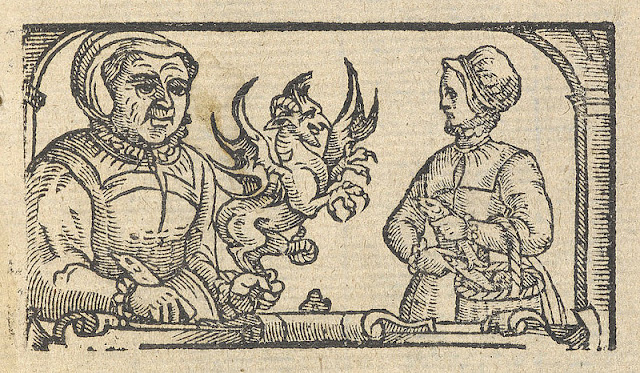

The folkloric image of the crone was established through these images and repeated in similar pamphlets over the next century. These witches were usually bitter old women, who lived on their own, and kept cats or other animals as pets. The Wonderful Discoverie of the Witchcrafts of Margaret and Phillip Flower, Daughters of Joan Flower neere Beuer Castle (1619) and A Most Certain, Strange and True Discovery of a Witch (1643) are particularly famous examples that reinforced this archetype. Latent sexism and fear of those who lived on the fringe of society doubtless motivated much of this persecution. The latter pamphlet manages to mix sexism with scorn by doubting that women are even capable of performing the same sorcery that certain men have achieved:

Many are in a belief, that this silly sex of women by no means attaine to that so vile and damned a practice of sorcery and Witch-craft, in regard of their illiteratenesse and want of learning, which many men have by great learning done, Adam by temptation toucht and tasted the deceiving apple, so some high learnd & read by the same temptation that deceived him hath bin so insnared to contract with the Divel; as for example, in the instancing a few, as English Bacon of Oxford, Vandermast of Holland, Bungay of Germany, Fostus of the same, Franciscus the English Monke of Bury, Doctor Slackleach and divers others which were too tedious to relate of, but how weake women should attain unto it many are incredible of the same, and many too are opposite in opinion against the same, that giving a possibility to their doubtings, that the malice, and inveterate malice of a woman entirely devoted to her revengefull wrath frequenting desolate and desart places, and giving way unto their wished temptation, may have converse with that world roaring lion.


In 1589, King James VI of Scotland sailed to Copenhagen to marry Princess Anne of Denmark. The return journey was troubled by bad weather and during their voyage to Scotland terrible storms forced the ship to seek shelter in Norway. The voyage was finally completed safely, but all involved were suitably rattled. In a stunning series of events, Danish courtiers subsequently accused women of sabotaging the journey using magic, prompting witchcraft trials first in Denmark and later, when James decided to follow suit, in North Berwick, Scotland. Several Scottish nobles were implicated and the seething jealousies and suspicions of two Royal houses bubbled into further accusations on both sides of the North Sea. King James grew paranoid that his life was in danger from witches, personally examined those on trial, and caused over a hundred people to be arrested. A 1591 pamphlet, Newes from Scotland, Declaring the Damnable Life of Doctor Fian, a Notable Sorcerer, who was Burned at Edenbrough in Januarie Last, 1591, chronicled the sensational trials and featured two illustrations with a number of interesting details.

The primary woodcut condenses several episodes from the story into a single image. 
The witches were accused of sending devils to stir up waves, and in the top left of the image, demons are seen swimming around James’ ship. In the top right, women are portrayed toiling around a cauldron, suggestive of sorcery, as they watch the fire burn, and cauldron bubble.


Here we find witches and demons dancing together, wax poppets baptised by the devil, spirits leaping from a circle of flames, and a feast at the witches’ sabbath. This is an energetic and dynamic portrayal of witchcraft, much more tantalising than old women with a chip on their shoulder. Whether the authors intended it or not, they managed to make witchcraft seem rather exciting and attractive. The stories are easy, compelling reads and the images feature young men and women doing extraordinary things. There is also a clear undercurrent of eroticism running through both books. There are numerous mentions of carnal acts, lusty satyrs, undressings, drunken feasts, love spells and devilish, handsome men appearing to innocent, young maids.

After the initial witchcraft pamphlets in the late sixteenth century, the publications became increasingly stylized in the seventeenth. As King James grew more and more sceptical about the reality of witches, his kingdom slowly grew more and more paranoid. It took decades for the hysteria to subside. While the early pamphlets were based on relatively sober court records, later pamphlets took more time to describe the accused’s terrible tortures, or the wondrous miracles they had performed. By the time popular histories of witchcraft were published, sensationalism ruled and the woodcuts became more striking. In a period racked with plague, civil war, and poverty, there must have been a certain sympathy for the devil.

FENRIR


Fenrir (pronounced “FEN-reer;” Old Norse Fenrir, “He Who Dwells in the Marshes”) is the most infamous of the many wolves in Norse mythology. His importance for the pre-Christian Scandinavians is demonstrated by his being depicted on numerous surviving runestones, not to mention his ubiquity in Old Norse literary sources.
He’s the son of the god Loki and the giantess Angrboða, which makes him the brother of the serpent Jormungand and the underworld goddess Hel.

As is recounted more fully in the tale The Binding of Fenrir, the Aesir gods raised Fenrir themselves in order to keep him under their control and prevent him from wreaking havoc throughout the Nine Worlds. He grew at an astonishingly fast pace, however, and eventually the troubled gods decided to chain him up. Their first two attempts were unsuccessful; while the cunning gods convinced Fenrir that it was only a game, a test of his strength, he broke through the fetters easily. For their third attempt, the gods had the dwarves forge the strongest chain ever built, which nevertheless gave the appearance of being very light and even soft to the touch. When the gods presented Fenrir with this third fetter, he became suspicious, and he refused to be bound with it unless one of the gods would stick his or her hand in his mouth as a pledge of good faith. Only Tyr was brave enough to do this, knowing that it would mean the loss of his hand. And, sure enough, when Fenrir found himself unable to break free of his bonds, he ripped Tyr’s hand from its arm. The chain was then tied to a boulder and a sword was placed in Fenrir’s jaws to hold them open. As he howled wildly and ceaselessly, a foamy river called “Expectation” (Old Norse Ván) flowed from his drooling mouth.

As the river’s ominous name implies, this was not the end of Fenrir. At Ragnarok, he broke free and ran throughout the world with his lower jaw against the ground and his upper jaw in the sky, devouring everything in his path. He even killed the god Odin before finally being put to death by one of Odin’s avenging sons.


Fenrir and Other Wolves in Norse Mythology

There’s good reason to think that many of the other wolves mentioned in Old Norse literature are actually Fenrir going under different names. One Old Norse poem states that he swallows the sun during Ragnarok, a feat which is elsewhere reserved for another wolf named Sköll (“Mockery”). Another old Norse poem repeatedly mentions a wolf named Garmr who breaks free from chains at Ragnarok; this is almost certainly Fenrir. In another source, we find the wolf who consumes the moon called by the name of “Moon-garmr” (Mánagarmr). Thus, the moon-eating wolf, who is elsewhere called Háti (“Hatred”) would seem to be another extension of Fenrir. It appears that it was ultimately Fenrir who, in addition to killing Odin and destroying much of the world, ate the sun and the moon during Ragnarok.

Poetic Edda

Fenrir is mentioned in three stanzas of the poem Völuspá and in two stanzas of the poem Vafþrúðnismál. In stanza 40 of the poem Völuspá, a völva divulges to Odin that, in the east, an old woman sat in the forest Járnviðr "and bred there the broods of Fenrir. There will come from them all one of that number to be a moon-snatcher in troll's skin.

"Then is fulfilled Hlín's
second sorrow,
when Óðinn goes
to fight with the wolf,
bright, against Surtr.
Then shall Frigg's
sweet friend fall.

In the stanza that follows the völva describes that Odin's "tall child of Triumph's Sire" (Odin's son Víðarr) will then come to "strike at the beast of slaughter" and with his hands he will drive a sword into the heart of "Hveðrungr's son," avenging the death of his father.

In the first of two stanzas mentioning Fenrir in Vafþrúðnismál Odin poses a question to the wise jötunn Vafþrúðnir:

"Much I have travelled, much have I tried out,
much have I tested the Powers;
from where will a sun come into the smooth heaven
when Fenrir has assailed this one?"

In the stanza that follows Vafþrúðnir responds that Sól (here referred to as Álfröðull) will bear a daughter before Fenrir attacks her, and that this daughter shall continue the paths of her deceased mother through the heavens


The Met Opera’s ‘Rusalka’ Is a Dark, Sexy Hit


The Metropolitan Opera’s new production of Dvorak’s “Rusalka” may be the unlikeliest hit of the season, a staging that takes opera’s answer to “The Little Mermaid” fairy tale and turns it into an almost shockingly dark, sexy drama. The mysterious look of the production, fantastical and ominous, combines with the sensual singing of a handsome cast to create a romantic energy rare at the Met — or at any opera house.

When this project was first announced, “Rusalka” seemed a promising match for the director Mary Zimmerman, best known for casting fairy tale magic in her Tony Award-winning “Metamorphoses.” But many were wary. Her three previous productions for the company, though full of ideas, were all variously disappointing. With this “Rusalka,” though, Ms. Zimmerman comes into her own as a director at the Met.

Working with the set designer Daniel Ostling, the costume designer Mara Blumenfeld and the lighting designer T. J. Gerckens, Ms. Zimmerman has explored the dark complexities of this fable. At the opening on Thursday, Mark Elder conducted a glowing account of Dvorak’s score. And the Met has assembled a matchless cast, led by the lovely soprano Kristine Opolais, who gives a vocally lustrous and achingly vulnerable performance as Rusalka, the water nymph who falls in love with a human prince.


The opening scene is set in a meadow by a pond, and in this staging, everything seems a little off. The pond is a forbidding pool from which mists slowly spew; the willow tree on which Rusalka rests is twisted and creepy. Dancing wood sprites (including a singing trio: Hyesang Park, Megan Marino and Cassandra Zoé Velasco) prance around in curiously ornate costumes, with frilly foliage skirts and headdresses of prickly twigs. As Vodnik, the water gnome who presides over the meadow, the earthy, stentorian bass-baritone Eric Owens looks endearingly foolish in a mock-courtly robe and crown.

When Rusalka, who is Vodnik’s daughter, starts to tell her father about her sorrows and longing, Ms. Opolais, with golden hair and a far-off gaze, wears an aqua gown with long, flowing trails, almost like rivulets of lake water. The cumbersome dress weighs her down: This is just one detail of many with which Ms. Zimmerman suggests that Rusalka is not just part of, but bound by, the natural world. And with her fidgety physical gestures and darting eyes, Ms. Opolais conveys the character’s restlessness and pining. This powerful singing actress adds unusual intensity to her plaintive “Song to the Moon,” Rusalka’s famed lament, suggesting the character’s defiant side more than most sopranos.


By the end of the opera, when Rusalka has fled the castle and returned to her pond, Ms. Zimmerman has turned the meadow gray and dank; the set’s scaffolding is partly exposed. Or is this just the way it appears to Rusalka? Perhaps she now sees, with painful clarity, the bare beams that prop up the seemingly rich natural world. The prince has gone in search of Rusalka, and finds her: Now, finally, the two have a real love duet, impassioned, fitful music, sung here with burnished sound and wrenching beauty by Ms. Opolais and Mr. Jovanovich.

But the doomed Rusalka has become a moonlit phantom, as she warns the prince. By kissing her, he dies. In a final directorial gesture, before heading alone into the forest, Rusalka puts on the prince’s coat. This time, though, it seems a token of remembrance.


Traduzir para ChinêsTraduzir para Espanholtraduzir para françêstraduzir para inglêstraduzir para alemãotraduzir para japonêsTraduzir para Russo


MikeLiveira's Space on Tumblr