todo o material postado no blog pode ser encontrado na internet
Showing posts with label occult. Show all posts

Tarots and Tarotology

The tarot ( first known as trionfi and later as tarocchi, tarock, and others) is a pack of playing cards, used from the mid-15th century in various parts of Europe to play games such as Italian tarocchini and French tarot. In the late 18th century, it began to be used for divination in the form of tarotology/cartomancy.
Like common playing cards, the tarot has four suits (which vary by region: French suits in Northern Europe, Latin suits in Southern Europe, and German suits in Central Europe). 
Each suit has 14 cards, ten cards numbering from one (or Ace) to ten and four face cards (King, Queen, Knight, and Jack/Knave). In addition, the tarot has a separate 21-card trump suit and a single card known as the Fool. Depending on the game, the Fool may act as the top trump or may be played to avoid following suit.
Tarot cards are used throughout much of Europe to play card games. In English-speaking countries, where these games are not played, tarot cards are used primarily for divinatory purposes. 
The Trump cards and the Fool are sometimes called "the major arcana" while the ten pip and four court cards in each suit are called minor arcana. The cards are traced by some occult writers to ancient Egypt or the Kabbalah but there is no documented evidence of such origins or of the usage of tarot for divination before the 18th century.

Tarot card games
The original purpose of tarot cards was to play games, the first rules appearing in the manuscript of Martiano da Tortona before 1425, and the next from the year 1637. 
The game of tarot has many cultural variations. Tarocchini has survived in Bologna and there are still others played in Piedmont and Sicily, but in Italy the game is generally less popular than elsewhere.
The 18th century saw tarot's greatest revival, during which it became the most popular card game in Europe, played everywhere except Ireland and Britain, the Iberian peninsula, and the Ottoman Balkans. French tarot experienced a revival beginning in the 1970s and France has the strongest tarot gaming community. Regional tarot games—often known as tarock, tarok, or tarokk are widely played in central Europe within the borders of the former Austro-Hungarian empire.

  • Divinatory, esoteric, and occult tarot
Divination using playing cards is recorded as early as 1540. A manuscript from 1750 (Pratesi Cartomancer) documents rudimentary divinatory meanings for the cards of the tarot. In 1765, Giacomo Casanova wrote in his diary that his Russian mistress frequently used a deck of cards for divination.

  • Tarotology 
is the theoretical basis for the reading of Tarot cards, a subset of cartomancy, which is the practice of using cards to gain insight into the past, present or future by posing a question to the cards. 
The reasoning behind this practice ranges from believing the result is guided by a spiritual force, to belief that the cards are instruments used to tap either into a collective unconscious or into the subject's own creative, brainstorming subconscious.
Tarot cards were originally used in games and are still used for that purpose in many parts of Europe.
Tarotology is not considered a science; there is no scientific evidence that readings made from the cards can play a role in making objective predictions about future events.

The main article on Tarot gives full details of the history of Tarot cards as game-playing cards.
https://en.wikipedia.org/wiki/Tarotology

Getting Witchy, Claude Gillot


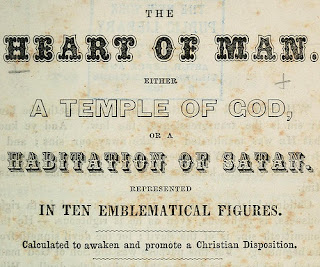
The Heart of Man; Either a Temple of God, or a Habitation of Satan; Represented in Ten Emblematical Figures (1851)


The following illustrations — which, in a wonderful marriage of word and image, plot out the life of the Christian soul — form the central strain in The Heart of Man: Either a Temple of God, or a Habitation of Satan: Represented in Ten Emblematical Figures, Calculated to Awaken and Promote a Christian Disposition (1851), an English edition of a German book published in 1812 in Berlin by the “divine” and philanthropist Johannes Gossner (1773-1858). 
Gossner’s work was itself actually a repurposing of an older text, a Catholic emblem book first published in French and which Gossner claims came to him by way of a German version published in Wurzburg in 1732. Although in his introductory note to the reader, Gossner gives the title of this book as Geistlicher Sittenspiegel (Spiritual Mirror of Morality), Peter Daly in his The Emblem in Early Modern Europe (2014), believes the title to actually be Geistlicher Seelen-Spiegel, and the publication date to be 1733. 
As for the wonderful images, Daly believes them to be based either on an earlier series of twelve illustrations “probably dating from the 1680s, or on the equally popular book in France about 1730 with the title Miroir de l’Ame or Miroir Pecheur with engravings by P. Gallays”. 
For some reason Gossner left out two images from this earlier series of twelve, “the last image showing the pious in paradise, as well as plate 5 with Christ sitting in the middle of the heart”. 
David Morgan, in his The Forge of a Vision(2015), traces the influence of this particular genre of heart imagery back further to the Flemish illustrator Antoine Wierix’s Cor Jesu amanti sacrum, published in 1595.


WEIRD MONSTERS OF JAPANESE FOLKLORE

There’s an ancient Japanese legend of the one hundred yōkai—monsters, ghosts, apparitions and demons—who parade through the streets on hot summer nights. If anyone is unfortunate to see these creatures—or to be caught up in it—then they will perish away or worse be taken captive for the twisted pleasure.
If you’ve ever watched the enjoyable trilogy of movies Yokai Monsters—One Hundred Monsters (1968), Spook Warfare (1968), and Along With Ghosts (1969)—then you’ll have a good idea what these demons look like—ogres, goblins, ghosts, sprites, spooky umbrellas and dangerous women with ever-extending serpentine necks.

All of these incredible monsters have long been a part of Japanese folklore. They were first codified in the supernatural bestiary—Gazu Hyakki Yagyō (The Illustrated Night Parade of a Hundred Demons) by artist and scholar Toriyama Sekien in 1776. It’s a kind of fabulously illustrated Fantastic Beasts and Where to Find Them but far, far more beautiful and eerie.

In 1881, artist Nabeta Gyokuei updated this incredible volume when he produced a picture book or e-hon of Sekien’s 100 demons. The Kaibutsu Ehon or Illustrated Book of Monsters features beautiful woodblock prints of each of the yōkai and its special powers.

The whole book can be viewed here.


Ubagabi—the ghost of an old woman that appears as fireball.


Aoi no Ue—fictional female character from ‘The Tale of Genji’ who is possessed by demons.

Waraime or Kerakera—a giant cackling woman who brings misfortune.

Kasha—a fiery yōkai—or phantom-in this case a cat that steals or devours corpses.


Shuten Dōji—a brutal and fearsome oni—or demon—known for kidnapping,
enslaving and devouring young Kyoto maidens. One of the three great evil yokai.

Woodcuts and Witches

from Public Domain Review


The publishing revolution of the sixteenth and seventeenth centuries witnessed an explosion of printed material, democratising information and pushing it into the hands and sight of more people than ever before. A large single sheet of cheap paper could be printed with a proclamation, adorned with a woodcut, and sent out among the masses. These broadsides were sold for a penny on street corners, pasted on ale-house walls, and stuck up on market posts.
In 1592, the playwright and stationer Henry Chettle described how ballads “infected London the eie of England”, then travelled through the country via ballad-mongers, who could “spred more pamphlets by the State forbidden than all the Booksellers in London”.
1 There was a hunger (then as now) for tales of sex and scandal and, for the first time, a network of illustrators, printers, and distributors were able to glut this desire. The Jacobean playwright Thomas Middleton referred to ballads as “fashions, fictions, felonies, fooleries”.
2 Cheap print was the medium of the masses, and the crude woodcuts were the visual language of Early Modern England.

This revolution in publishing coincided with what has been termed “the European witch-craze”: a moral panic and collective psychosis that spread through Europe and Scandinavia during the sixteenth and seventeenth centuries. The seed of this hysteria was planted in 1484 when two Dominican Inquisitors appealed to Pope Innocent VIII for permission to launch a witch hunt, and he responded by issuing a papal bull authorizing their efforts. 
Two years later they published their treatise, the Malleus Maleficarum (“Hammer of the Witches”), which, for the first time, elevated witchcraft to the crime of heresy and justified its extermination with papal authority. Leaning heavily on the supposed papal endorsement, the Malleus Maleficarum painted a terrifying picture of witchcraft and preached the absolute necessity of vanquishing this largely unrecognised evil.


Apparently, witches were everywhere. Torture was recommended for extracting confessions, the death penalty was revealed as the only remedy against sorcery, and burning at the stake was proposed as a suitable method of execution. With one fell swoop, the persecution of witches was begun and an entire methodology was established. The book was a bestseller and strongly influenced the obsession with witchcraft for two hundred years, spreading slowly through continental Europe and then the Scandinavian countries, which became particularly obsessed with the subject. 
In Britain, the witch-craze hit later, but was rewarded with numerous pamphlets and ballads devoted to salacious details of devilish mischief.

One of the earliest and most notorious British witchcraft pamphlets was published in 1579:
A Rehearsall both Straung and True, of Hainous and Horrible Actes Committed by Elizabeth Stile, alias Rockingham, Mother Dutten, Mother Deuell, Mother Margaret, Fower Notorious Witches.
Stile was a 65-year-old widow and beggar accused of bewitching an innkeeper. The pamphlet describes her association with three other old women known as Mother Margaret, Mother Dutten and Mother Devell, as well as a man named Father Rosimunde, who could transform himself “into the shape and likenesse of any beaste whatsoever he will”. Woodcuts show these old women and several animal familiars, which they reportedly fed on their own blood.


The folkloric image of the crone was established through these images and repeated in similar pamphlets over the next century. These witches were usually bitter old women, who lived on their own, and kept cats or other animals as pets. The Wonderful Discoverie of the Witchcrafts of Margaret and Phillip Flower, Daughters of Joan Flower neere Beuer Castle (1619) and A Most Certain, Strange and True Discovery of a Witch (1643) are particularly famous examples that reinforced this archetype. Latent sexism and fear of those who lived on the fringe of society doubtless motivated much of this persecution. The latter pamphlet manages to mix sexism with scorn by doubting that women are even capable of performing the same sorcery that certain men have achieved:

Many are in a belief, that this silly sex of women by no means attaine to that so vile and damned a practice of sorcery and Witch-craft, in regard of their illiteratenesse and want of learning, which many men have by great learning done, Adam by temptation toucht and tasted the deceiving apple, so some high learnd & read by the same temptation that deceived him hath bin so insnared to contract with the Divel; as for example, in the instancing a few, as English Bacon of Oxford, Vandermast of Holland, Bungay of Germany, Fostus of the same, Franciscus the English Monke of Bury, Doctor Slackleach and divers others which were too tedious to relate of, but how weake women should attain unto it many are incredible of the same, and many too are opposite in opinion against the same, that giving a possibility to their doubtings, that the malice, and inveterate malice of a woman entirely devoted to her revengefull wrath frequenting desolate and desart places, and giving way unto their wished temptation, may have converse with that world roaring lion.


In 1589, King James VI of Scotland sailed to Copenhagen to marry Princess Anne of Denmark. The return journey was troubled by bad weather and during their voyage to Scotland terrible storms forced the ship to seek shelter in Norway. The voyage was finally completed safely, but all involved were suitably rattled. In a stunning series of events, Danish courtiers subsequently accused women of sabotaging the journey using magic, prompting witchcraft trials first in Denmark and later, when James decided to follow suit, in North Berwick, Scotland. Several Scottish nobles were implicated and the seething jealousies and suspicions of two Royal houses bubbled into further accusations on both sides of the North Sea. King James grew paranoid that his life was in danger from witches, personally examined those on trial, and caused over a hundred people to be arrested. A 1591 pamphlet, Newes from Scotland, Declaring the Damnable Life of Doctor Fian, a Notable Sorcerer, who was Burned at Edenbrough in Januarie Last, 1591, chronicled the sensational trials and featured two illustrations with a number of interesting details.

The primary woodcut condenses several episodes from the story into a single image. 
The witches were accused of sending devils to stir up waves, and in the top left of the image, demons are seen swimming around James’ ship. In the top right, women are portrayed toiling around a cauldron, suggestive of sorcery, as they watch the fire burn, and cauldron bubble.


Here we find witches and demons dancing together, wax poppets baptised by the devil, spirits leaping from a circle of flames, and a feast at the witches’ sabbath. This is an energetic and dynamic portrayal of witchcraft, much more tantalising than old women with a chip on their shoulder. Whether the authors intended it or not, they managed to make witchcraft seem rather exciting and attractive. The stories are easy, compelling reads and the images feature young men and women doing extraordinary things. There is also a clear undercurrent of eroticism running through both books. There are numerous mentions of carnal acts, lusty satyrs, undressings, drunken feasts, love spells and devilish, handsome men appearing to innocent, young maids.

After the initial witchcraft pamphlets in the late sixteenth century, the publications became increasingly stylized in the seventeenth. As King James grew more and more sceptical about the reality of witches, his kingdom slowly grew more and more paranoid. It took decades for the hysteria to subside. While the early pamphlets were based on relatively sober court records, later pamphlets took more time to describe the accused’s terrible tortures, or the wondrous miracles they had performed. By the time popular histories of witchcraft were published, sensationalism ruled and the woodcuts became more striking. In a period racked with plague, civil war, and poverty, there must have been a certain sympathy for the devil.

spider-trickster, ANANSI


Anansi is an African folktale character. He often takes the shape of a spider and is considered to be the spirit of all knowledge of stories. He is also one of the most important characters of West African and Caribbean folklore.
He is also known as Ananse, Kwaku Ananse, and Anancy; and in the southern United States he has evolved into Aunt Nancy. He is a spider, but often acts and appears as a man.

The Anansi tales originated from the Ashanti people of present-day Ghana. The word Ananse is Akan and means "spider". They later spread to other Akan groups and then to the West Indies, Suriname, Sierra Leone (where they were introduced by Jamaican Maroons) and the Netherlands Antilles. On Curaçao, Aruba, and Bonaire, he is known as Kompa Nanzi, and his wife as Shi Maria.

Anansi is depicted in many different ways. Sometimes he looks like an ordinary spider, sometimes he is a spider wearing clothes or with a human face and sometimes he looks much more like a human with spider elements, such as eight legs.


In Western African tradition, there is no deity that is better known than the shape-shifting spider-trickster, ANANSI, the spider god and the owner of all stories! Originally coming off as a creator god in his earliest days, he evolved over time to be widely known as a crafty and cunning trickster who could bamboozle and fool other animals and humans, usually in sly and witty ways. 
Though he usually was able to get whatever it was that he wanted through elaborate ruses, once in a great while, his trickery would backfire upon him, leaving HIM to be the object of a lesson in life!

Stories of Anansi, called Anansesem ("spider tales"), exist around most West African nations and he is also widely known in the West Indies, where his stories traveled with unfortunate slaves who brought his legends with them on the horrible journey. It is unclear whether his original form was spider or human though he is represented as taking spider form whenever he gets into trouble, which allows him to escape any consequences! Even today in modern Ghana, generations of children grow up with the many humorous and fantastical cautionary tales and funny fables of the wacky, wild and mostly-wise Anansi!

Edward Curtis’ Photographs of Kwakwaka’wakw Ceremonial Dress and Masks (ca. 1914)

The Kwakwa̱ka̱’wakw (or Kwakiutl) are an indigenous people of the Pacific Northwest Coast, covering the territory of British Columbia on northern Vancouver Island and the adjoining mainland, and on islands around Johnstone Strait and Queen Charlotte Strait. United by the common language of Kwak’wala, the broad group can be divided into 13 nations, each with its own clan structure and distinct histories. According to Kwakwaka’wakw folklore their ancestors (‘na’mima) came to a given spot — by way of land, sea, or underground — in the form of ancestral animals that upon arrival shed their animal appearance and became human.


The first documented contact with Westerners was in 1792 during the expedition led by English officer Captain George Vancouver, and was soon followed by colonies of Europeans settling on Canada’s West Coast. As was often the way, with settlers came disease and the Kwakwaka’wakw population dropped by up to 75% between 1830 and 1880. Their distinctive ideas about wealth — that status came not from how much you owned but how much you were able to give away — came to the particular attention of the US anthropologist Franz Boas, who wrote extensively on their elaborate gift-giving ceremonies known as “potlach”. The ceremonial practice was also a particular target of Christian missionaries who saw it as a major obstacle to their “civilising” mission, and the Canadian government banned the practise in 1885 (although the act was soon amended, proving impossible to enforce).

The photographs of the ceremonial dress and masks of the Kwakwaka’wakw presented here are the creation of American photographer and ethnologist Edward Curtis (1868–1952), famous for his work with Native American people. Part of a project funded by banking magnate J.P. Morgan, these photographs are from the collection held at the Library of Congress, and contain many images not published in Curtis’ enormous twenty-volume The North American Indian. In 2015, Taschen produced their epic 768-page The North American Indian: The Complete Portfolios, which gathers Curtis’ entire American Indian portfolio into one publication.

Traduzir para ChinêsTraduzir para Espanholtraduzir para françêstraduzir para inglêstraduzir para alemãotraduzir para japonêsTraduzir para Russo


MikeLiveira's Space on Tumblr